Who Gets to Take a Risk? Why America Builds Giants While Young Nigerians Struggle to Get a Chance
Why does America have an ecosystem willing to invest in ambitious startups while young Nigerian entrepreneurs struggle to secure their first opportunity? The difference is not simply talent or ambition. It is access to patient capital, supportive institutions and a culture that understands the risks of innovation. This article explores the funding inequality and asks what hope remains for young Nigerian founders.
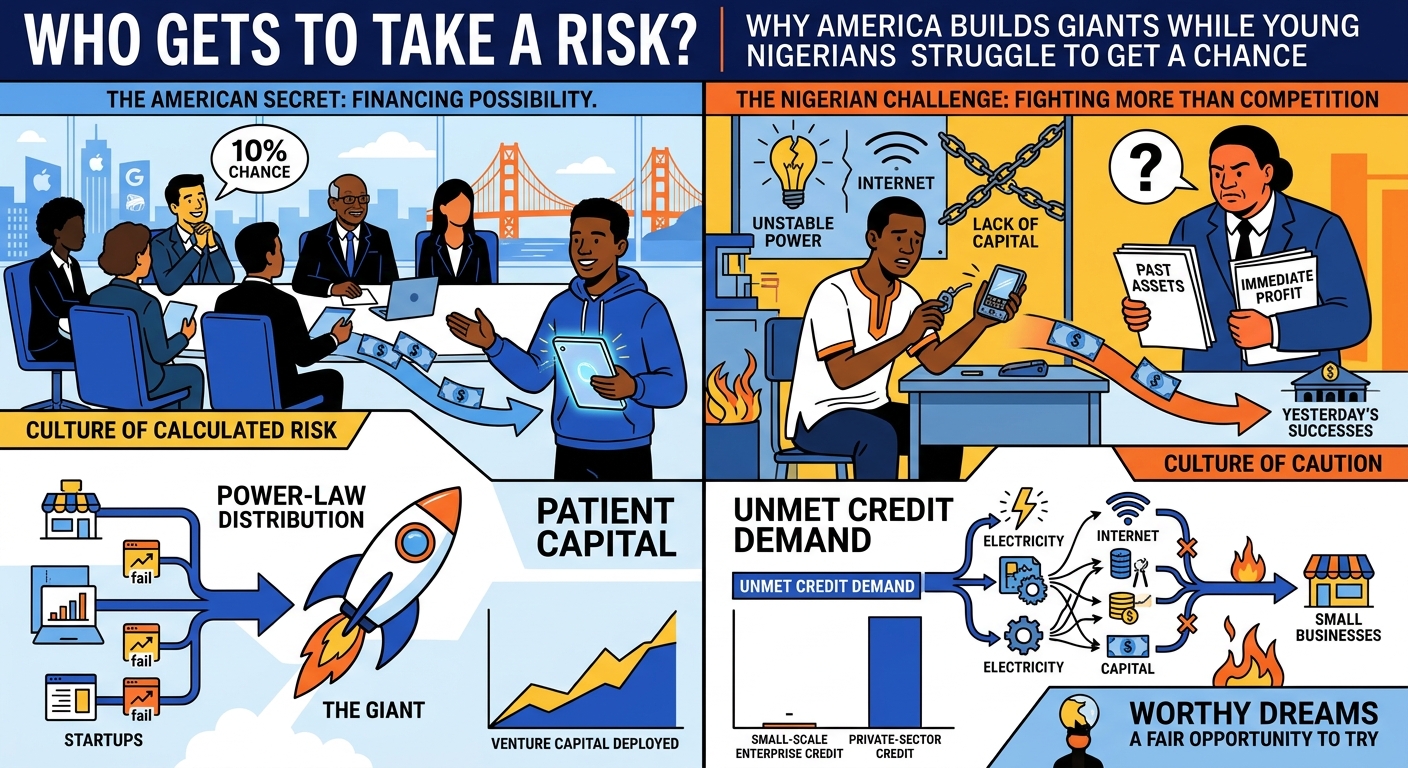
Who Gets to Take a Risk? Why America Builds Giants While Young Nigerians Struggle to Get a Chance There is something I have been thinking about for a while, and perhaps you should think about it too. Imagine a young man in Nigeria. He has an idea. Not just another idea about buying and selling, but something capable of solving a real problem. He spends months researching, learning, writing code, building prototypes and trying to convince people that what he sees in his imagination can become a business. He finally gets something working. Perhaps it is a technology product, an agricultural solution, an artificial intelligence application or an affordable clean-energy innovation. He needs money to move from the experimental stage to the commercial stage. He approaches someone who has money. The first question is not necessarily how many people will benefit from the innovation. It is how much money he has already made, what assets he can present, how quickly the investment will be recovered and what happens if the business fails. Sometimes, the conversation ends before the business even gets a chance to begin. Now imagine another young founder somewhere in Silicon Valley. The founder has a prototype, a compelling market opportunity and a team willing to execute. The business is not yet profitable. Its future is uncertain. Nevertheless, there are investment firms whose entire business model revolves around identifying companies that could become enormously valuable. What is the difference? Is it that the American founder is more intelligent? Does the Nigerian founder lack ambition? Or have we built two different environments in which the same entrepreneurial courage receives entirely different financial treatment? I think the answer deserves more attention than we give it.
The American secret is not simply money. It is the willingness to finance possibility.
There is a popular argument that American investors are comfortable putting money into startups with perhaps a 10 per cent chance of becoming successful because they understand that one extraordinary company can compensate for several failed investments. There is truth in that thinking, although the 10 per cent figure should not be mistaken for an established industry rule. This is how venture capital works. Investors raise money from institutions, wealthy individuals, pension funds and other capital providers. They then distribute that money across a portfolio of young companies. Some companies will fail. Others may survive without producing extraordinary returns. A few may become exceptionally valuable. The investment strategy is built around the possibility that those exceptional companies will generate enough returns to compensate for the unsuccessful investments. Economists and venture capital researchers describe this as the power-law distribution of returns. A particularly interesting historical finding discussed in research published in the Socio-Economic Review showed that approximately 4.5 per cent of invested dollars generated roughly 60 per cent of total returns in one long-running venture capital investment dataset. Think about that. A relatively small portion of investments can generate a disproportionately large share of the returns. This is why an investor may consider a young company that has not yet established itself as a profitable business. The investor is not necessarily expecting every company to become successful. The investor is looking for the possibility of an extraordinary outcome. This is an important distinction. America does not have a magical system where everybody receives money for having an idea. It has a sophisticated investment ecosystem that understands calculated risk and knows how to distribute that risk across multiple investments.
The numbers tell an interesting story
According to the National Venture Capital Association's 2026 Yearbook, American venture capital deployed approximately $320 billion across 15,352 deals in 2025. Of that amount, approximately $22.3 billion went into 5,049 pre-seed and seed deals. That means thousands of companies received early-stage investment in a single year. However, we should not romanticise the American system. The same report shows that 65.4 per cent of venture capital deal value went into artificial intelligence. Furthermore, just 487 mega-deals, representing approximately 3.2 per cent of deal count, accounted for 67 per cent of total deal value. The money is substantial, but it is also concentrated. Still, the existence of a financial system capable of deploying that amount of capital creates opportunities that are difficult to replicate in an economy where young businesses struggle to obtain their first meaningful investment. The American advantage is not simply that investors are generous. It is the combination of capital markets, experienced investors, research institutions, accelerators, established companies, acquisition opportunities and a relatively deep market for raising and exiting investments. These institutions make it possible for an idea to move through different stages of development.
Now, let us come home to Nigeria.
It would be unfair to say that nobody invests in Nigerian startups. That would be factually incorrect. Partech's 2025 Africa Tech Venture Capital Report recorded approximately $412 million in Nigerian equity funding across 83 deals. Nigeria ranked third in Africa by equity funding, behind South Africa and Kenya. However, this represented a 21 per cent decline in equity funding compared with 2024. There is another interesting observation in the same report. Between 2021 and 2025, Nigeria recorded 513 Seed+ deals, representing approximately 26 per cent of Africa's total at that stage. So the entrepreneurial activity is there. Investors are present. Nigerian companies are receiving funding. The question is whether the capital available is sufficient, accessible and patient enough to support the enormous number of young people trying to build businesses. These figures also need perspective. The American and Nigerian funding numbers come from different reporting datasets and methodologies, so they should not be treated as a perfectly comparable market share calculation. Nevertheless, the difference in the scale of their investment ecosystems is striking.
The Nigerian entrepreneur is fighting more than business competition.
Sometimes, I wonder what we expect a young Nigerian entrepreneur to overcome before we consider that person worthy of investment. Electricity is a business expense. Internet access is a business expense. Equipment is expensive. Imported technology becomes more expensive when the currency loses value. Employees need salaries. Customers have limited purchasing power. And when the founder finally develops a product, the next challenge is finding affordable capital to take it to market. This is not an argument against accountability or due diligence. Investors have every right to protect their money. But we must recognise that the Nigerian entrepreneur often carries risks that have little to do with the quality of the business idea. The Development Bank of Nigeria's October 2026 research note, drawing on Central Bank of Nigeria data, highlights an uncomfortable reality. Small-scale enterprise credit represented just 0.38 per cent of private-sector credit in 2025. Meanwhile, MSMEs account for approximately 96.9 per cent of Nigerian businesses and 87.9 per cent of employment. The International Finance Corporation had also estimated unmet credit demand among Nigerian MSMEs at approximately ₦13 trillion, equivalent to $32.2 billion, based on its 2021–2022 research. What does this tell us? We have an economy that depends heavily on small businesses but struggles to provide them with the financial resources required to expand. And when the business is innovative, experimental or technology-driven, the challenge can become even more complicated. A 2025 academic study examining 335 African fintech startups, alongside interviews with founders and investors, found that founder networks, institutional weaknesses and perceptions of risk influence access to venture capital. It also identified historical advantages enjoyed by non-African founders through investor networks and familiarity. This suggests that the funding problem is not always about the quality of the idea. Sometimes, it is also about who gets access to the people capable of financing it.
Even Black founders in America are not enjoying equal opportunities.
There is another dimension to this conversation that deserves attention. It would be misleading to portray America as a perfect environment for every Black entrepreneur. According to Crunchbase's May 2026 analysis, startups with a Black founder or co-founder received approximately $942 million in American venture funding in 2025. That represented just 0.32 per cent of total US venture funding. Read that again. Even within one of the world's largest venture capital markets, Black founders remain significantly underrepresented in the distribution of investment capital. So, the issue is not simply that America believes in everybody and Nigeria believes in nobody. There are inequalities within the American system too. However, the existence of a large financial ecosystem means that there are still substantial pools of capital, investment institutions and alternative pathways available to founders who can navigate them. For a young Black Nigerian, the challenge can be even more complicated: building a business in an environment with limited early-stage capital while also trying to access international investment networks that may be unfamiliar with the local market.
And what exactly does an investor expect in return?
There is another misconception I would like us to address. Some people believe that investors who support startups must necessarily demand enormous dividends or take an unreasonable percentage of the business. That is not how venture capital generally works. When an investor purchases equity in a startup, the investor becomes a shareholder. The investment is usually expected to appreciate in value as the business grows. The investor may eventually make money when the company is acquired, lists publicly or provides an opportunity to sell shares to another investor. Dividends are possible, but they are rarely paid during the early growth stage because startups generally need to reinvest their earnings into expansion. In other words, an investor who puts money into a young technology company may be willing to wait several years before seeing a financial return. This is the kind of patient capital that an entrepreneurial ecosystem needs. Of course, investors must negotiate reasonable ownership, governance and financial protections. Founders must also understand the implications of the agreements they sign. But if every investment conversation begins and ends with how much immediate profit can be extracted, we may struggle to build companies that require years of research, experimentation and development before becoming commercially successful.
So, what hope is there for the young Nigerian?
I do not believe the answer is to sit down and complain that the system is against us. But I also do not believe that telling young people to work harder, wake up earlier and believe in themselves is sufficient. There are people who are already working hard. There are graduates who have spent years learning valuable skills. There are young engineers building applications, inventors experimenting with new technologies, farmers developing better production methods and entrepreneurs trying to solve problems that have existed for generations. Some of these people do not need another motivational speech. They need someone willing to give their work a genuine opportunity. Nigeria needs more angel investors who can write smaller early-stage cheques without demanding that every business already looks like a multinational company. We need investment funds that understand the difference between a business that is still validating its product and one that has already reached commercial maturity. We need universities that commercialise research, accelerators that connect founders to actual investors, established companies that support promising innovations and financial institutions willing to experiment with better ways of financing viable businesses. We also need more successful Nigerian entrepreneurs to become investors themselves. Imagine a situation where someone who built a successful company takes a portion of the wealth generated from that business and invests in five young founders. Perhaps three of those businesses will struggle. One may survive. Another may become a major company. That is how an entrepreneurial investment culture begins to develop. Young founders also have responsibilities. We must learn to build businesses around actual problems, validate our ideas with customers, maintain proper financial records and demonstrate that our products can work beyond a presentation or pitch deck. An investor should not be expected to finance an idea simply because its founder is passionate. But neither should a founder be expected to prove the entire future of a business before receiving the first opportunity to build it. There must be a meeting point between responsible investment and the willingness to take calculated risks.
We cannot build tomorrow's giants by financing only yesterday's successes.
Perhaps the greatest danger facing young Nigerian entrepreneurs is not a lack of ideas. It is the possibility that many valuable ideas will never progress beyond their earliest stages because the people behind them cannot afford the cost of experimentation. A country cannot consistently produce globally competitive companies if its young innovators are expected to finance every experiment from personal savings, family contributions and whatever income they can generate from unrelated jobs. We need a culture that understands that not every experiment will succeed, but that refusing to finance experiments also has a cost. The next great African technology company may be sitting in a small room somewhere in Nigeria today. Its founder may be using an ordinary laptop, struggling with electricity, working without a large team and trying to convince the world that a solution to a difficult problem is possible. Perhaps that company will fail. Perhaps it will become something extraordinary. But how will we ever know if nobody is willing to give it a chance? The question is not whether young Nigerians have the intelligence to build global companies. We have seen enough evidence to answer that. The real question is whether we are prepared to build an environment where their intelligence, creativity and courage can receive the financial support they deserve. Because a nation that only invests in businesses that have already succeeded is not necessarily building an entrepreneurial ecosystem. It may simply be rewarding those who managed to survive without one. Young Nigerians do not need somebody to guarantee that every dream will succeed. They need a system that gives worthy dreams a fair opportunity to try. See less
Design your own solar system
Use our free 16-step solar sizing tool to size panels, batteries, and inverters for your home or business.